F.01 · Voice & chat
Systems that talk to your customers
Answer the call or the chat, find out what the person needs, and hand the outcome to your team.
For small and mid-sized businesses
VelvoAI builds voice agents, workflow automation and AI products for law firms, clinics, property teams and service businesses.
Voice AI that answers, qualifies, and books 24/7
Fully automated workflows with multi-agent handoffs
Internal agentic copilots with grounded, cited answers
Twelve kinds of system. Each page covers the engineering behind one: the problem it removes, what ships with it, and the part most implementations get wrong.
Answer the call or the chat, find out what the person needs, and hand the outcome to your team.
Take the copying, chasing and follow-up out of your team's day.
Answers drawn from your own documents, and the data inside them extracted into your systems.
Agents, dashboards, integrations and AI products shaped to the systems you already run, plus advice on what to build first.
Not sure which of these you need? Bring the bottleneck rather than the solution.
Book a callThe same systems, framed around the workflows, tooling, and constraints of your industry.
12 sectors · swipe
One system in daily use that I built before VelvoAI, one personal build, and one demo you can call. Each page states exactly what my part was.
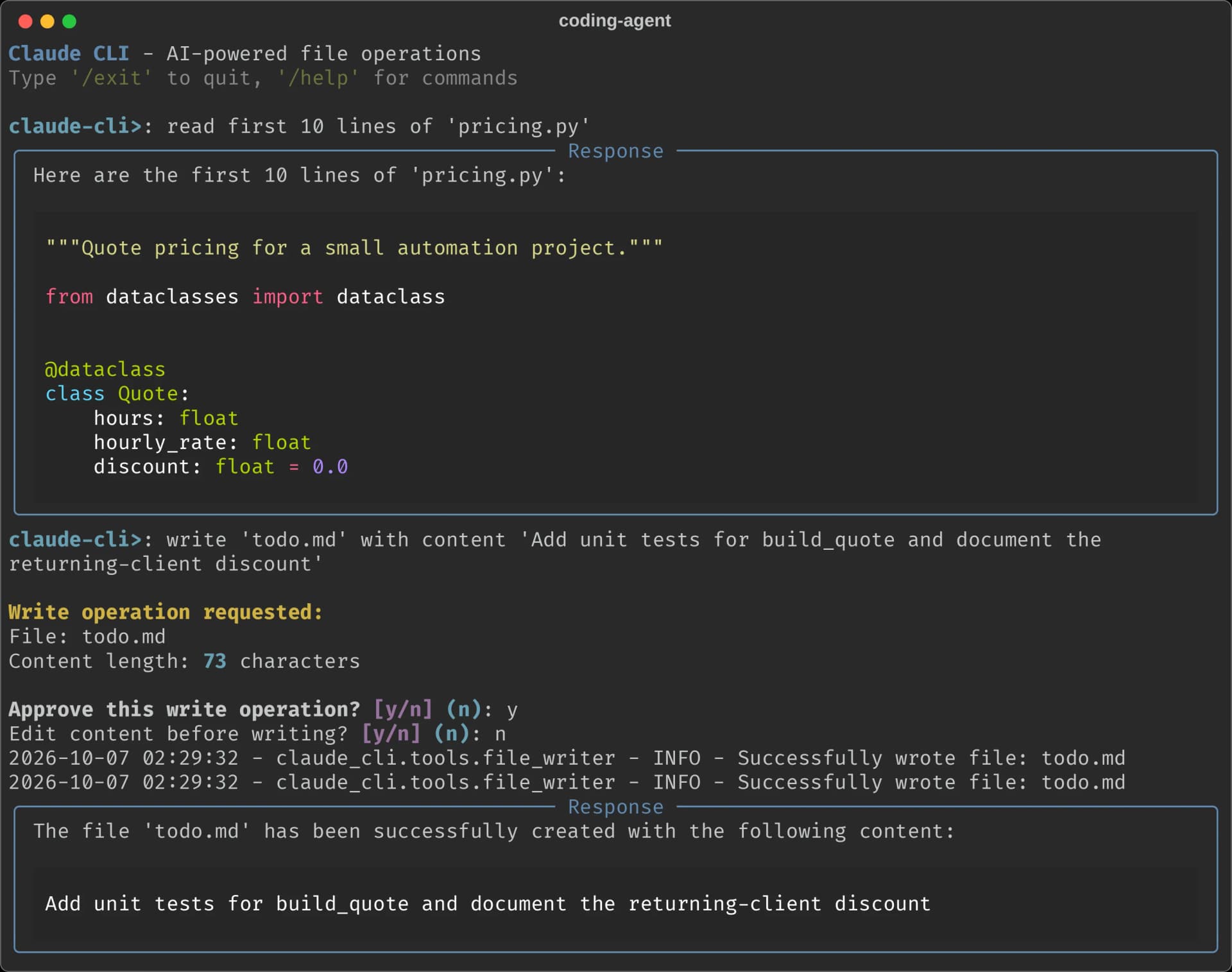
01 / 03Own build
A LangGraph Coding Agent
Self-built · personal project, not client work
Coding Agent · how a request is handled
02 / 03Live
AI Estimates from Sales Tasks
Sole engineer · built before VelvoAI
Problem
Estimate requests in ClickUp could arrive without a description, with information missing, filed in the wrong list, or as a test task rather than an estimate, and each one needs checking before anyone can price the work.
ClickUp
Task created or updated
Runs again only when the fields that matter change
n8n
Read the request
The description, plus text extracted from attached PDFs
GPT-4o
Check the task
Clear? An estimate? Enough detail? Which department? Right list?
Sent back with a ClickUp comment to the task creator
Sales fixes the task, and the workflow runs again
OpenAI
Draft the estimate
Phases and tasks, with hours
Google Docs
Write the estimate doc
Created and filled automatically
ClickUp
Team lead approves
A comment with the doc link asks the right team lead to sign off
Estimate Automation · how a sales task is handled
Live callIllustrative flow · AI demo line
03 / 03Demo
A Voice AI Demo
Self-built demo · never deployed for a client
Voice Receptionist · how a call is handled
Six steps, each ending in something you can hold: a written scope, a working slice, a runbook.
Deliverable
A written description of the bottleneck in your words, with the genuinely automatable parts separated from the parts that need a person.
Deliverable
A scope document naming every integration, the data that moves through each one, and the boundaries the system will not cross.
Deliverable
A narrow working slice at the end of the first week — small, but running.
One-week cycles
Deliverable
A test pass over your own edge cases, with every failure listed and what the system does about each one.
Deliverable
A running system plus a runbook: what it does, how to stop it, what each alert means, and who to call.
Deliverable
A written record of what changed and why, so the reasoning survives independently of me.
The weeks after launch
Dashed loops = repeat cycles · solid = forward handoff
See the full processOnly tools used in real builds, grouped by where they sit in a system.
AI systems engineering
VelvoAI builds AI systems for modern businesses that need better operations, not more noise. Every project starts with a specific bottleneck: missed leads, repetitive admin, slow research, scattered documents, weak reporting, or a product idea that needs a reliable AI foundation.
Best fit
The best fit is a business with a clear operational constraint and enough repeat volume for automation to matter. VelvoAI is built for teams that want AI doing real work inside the business, not experiments that stay disconnected from daily operations.
Teams that lose leads after hours, miss follow-ups, or need a faster way to qualify and book prospects.
Voice AI AgentsOperations that juggle orders, inventory, carriers, and exceptions across many systems, where multi-agent orchestration can coordinate each step and flag problems before they escalate.
AI for LogisticsCompanies with documents, SOPs, product knowledge, legal material, or internal data that people need to search and trust quickly.
RAG SystemsTeams that need a usable AI SaaS platform with authentication, billing, credits, admin tools, and production infrastructure.
AI SaaS DevelopmentOperational leverage
Businesses use AI systems when a process is important, repeated, and too expensive to keep handling manually. A well-built system can answer faster, work across tools, retrieve the right knowledge, and keep the operation moving even when the team is offline or busy.

Who builds it
Over five years of building software, most recently as a lead engineer on voice and retrieval systems. No account manager in between.
VelvoAI builds practical AI systems for business operations, including voice AI agents, workflow automations, internal copilots, RAG systems, document AI pipelines, integrations, dashboards, and full-stack AI SaaS products.
No. Many projects start with a normal operational problem such as missed calls, manual data entry, slow reporting, scattered documents, or repeated follow-ups. The AI system is designed after the workflow and business goal are clear.
Most projects aim for a first working production system in about four weeks, depending on integrations, data quality, review cycles, and security requirements. Smaller automations can move faster, while complex SaaS systems need a broader delivery plan.
Yes. VelvoAI designs systems around the tools your business already uses, such as CRMs, databases, email, phone systems, spreadsheets, dashboards, billing tools, and internal knowledge bases.
Every system ships with role-based access, secure workspaces, and human-review checkpoints for sensitive actions. Retrieval is grounded and cited so answers can be traced back to a source, and unclear cases are escalated to a person instead of guessed.
Fair question, and the answer is structural rather than reassuring. Code and credentials live in your accounts, not ours. Every build ships with a written handover covering the architecture, the runbook, and the reasoning behind the decisions that are not obvious from the code. You can hand the system to another engineer at any point without needing anything from us.

Next step
Bring the workflow, lead leak, reporting gap or knowledge bottleneck. You talk to the engineer who would build it, and leave knowing what it would take to ship.
Free, no obligation.